
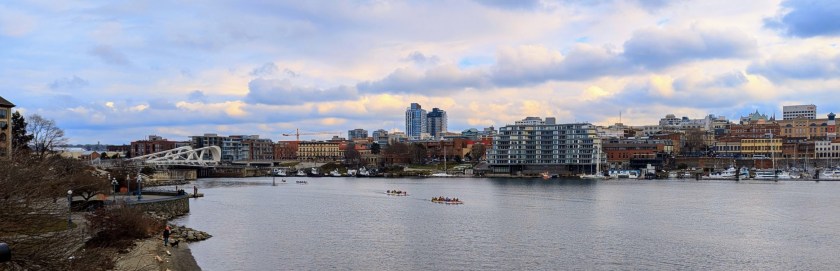
Us, in a race? Wonders never cease! On February 8 compete in a ten-kilometre double-hull outrigger canoe race through Victoria’s inner, middle, and outer harbours to the V21 buoy and back. With a finish time of 58:51, our twelve-paddler team doesn’t win first place, but the Fairway Gorge Paddling Club certainly accomplishes its mission: to bring people together through paddling.
Race day
It’s two degrees Celsius with mixed precipitation in the forecast, but we are race-ready. We’ve had oatmeal for breakfast, and Doug has purchased disposable gloves to use as liners under his neoprene ones, a strategy recommended by our team mates.
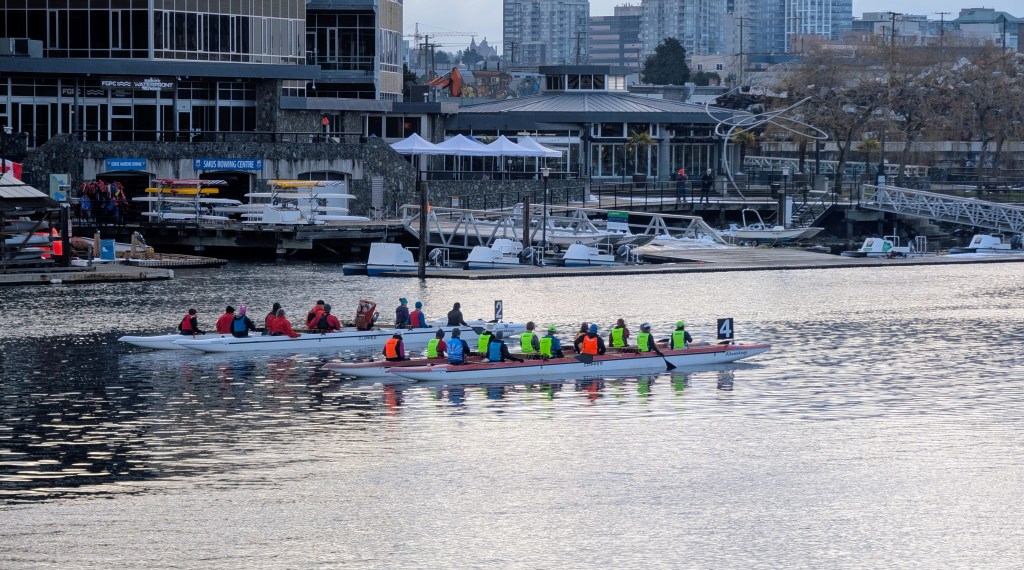
At 10 o’clock our race is yet to begin, but already we have been presented with a medal, created and hand-painted by our Steersperson, Sue. Then it’s time for last-minute adjustments to the layers we will wear. This is a personal – and critical – decision, because once the race is under way, there will be no stopping for wardrobe adjustments (or for nose-blowing).

We are the Harrison Islanders, named for a small rocky island near the entrance to Victoria Harbour. Our team, classed as Mixed Masters age 60+, has four men, who occupy the engine room seats (seats 4 and 5) and eight women, with Sue as the steersperson, Kathy (with a K) as lead stroke, and Shelley as caller.
Our race, Heat 2, starts promptly at 11:00am. For the next hour our focus is on the paddle blade of the team mate in front of us, so we don’t have many sightings to report as we paddle from the Fairway Gorge dock and through Victoria Harbour to V21 (the entrance buoy) and back, a total of ten kilometres. In our peripheral vision: a gaggle of geese, our daughter waving from Songhees Point, a seaplane taking off, and a floating hot tub.
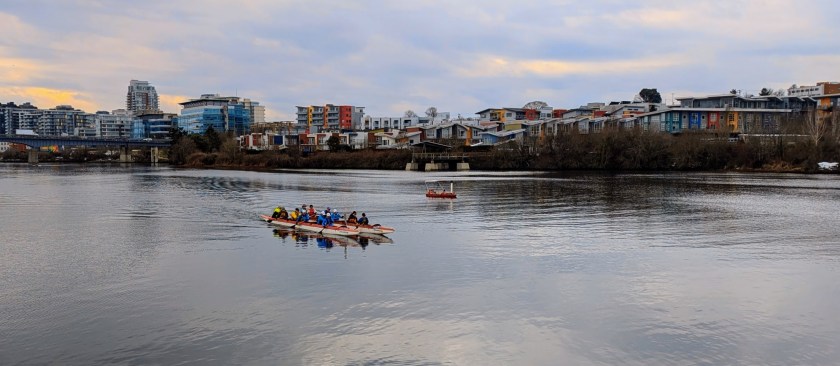
Back at the dock Debbie distributes donuts as Erik announces the results of the four-boat Heat 2: our time of 58:51 gives us second place (for overall results, click here ). Our team’s prize: a bag of Valentine-themed cookies.

Thanks, Harrison Islanders, for the opportunity to paddle with you. Thanks, too, – and photo credits – to our family cheering section: Kirsten, Nick, and Faheema.
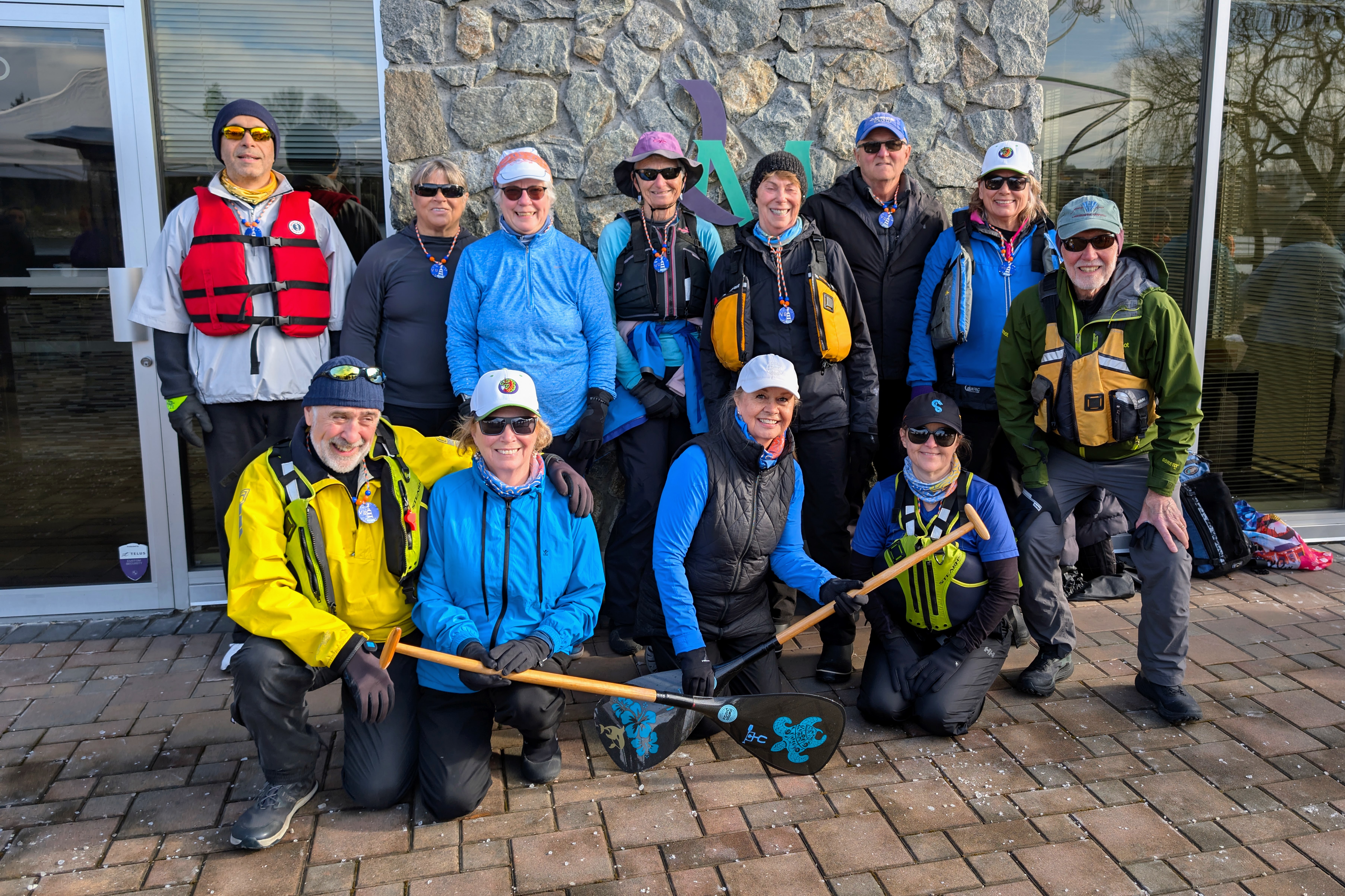
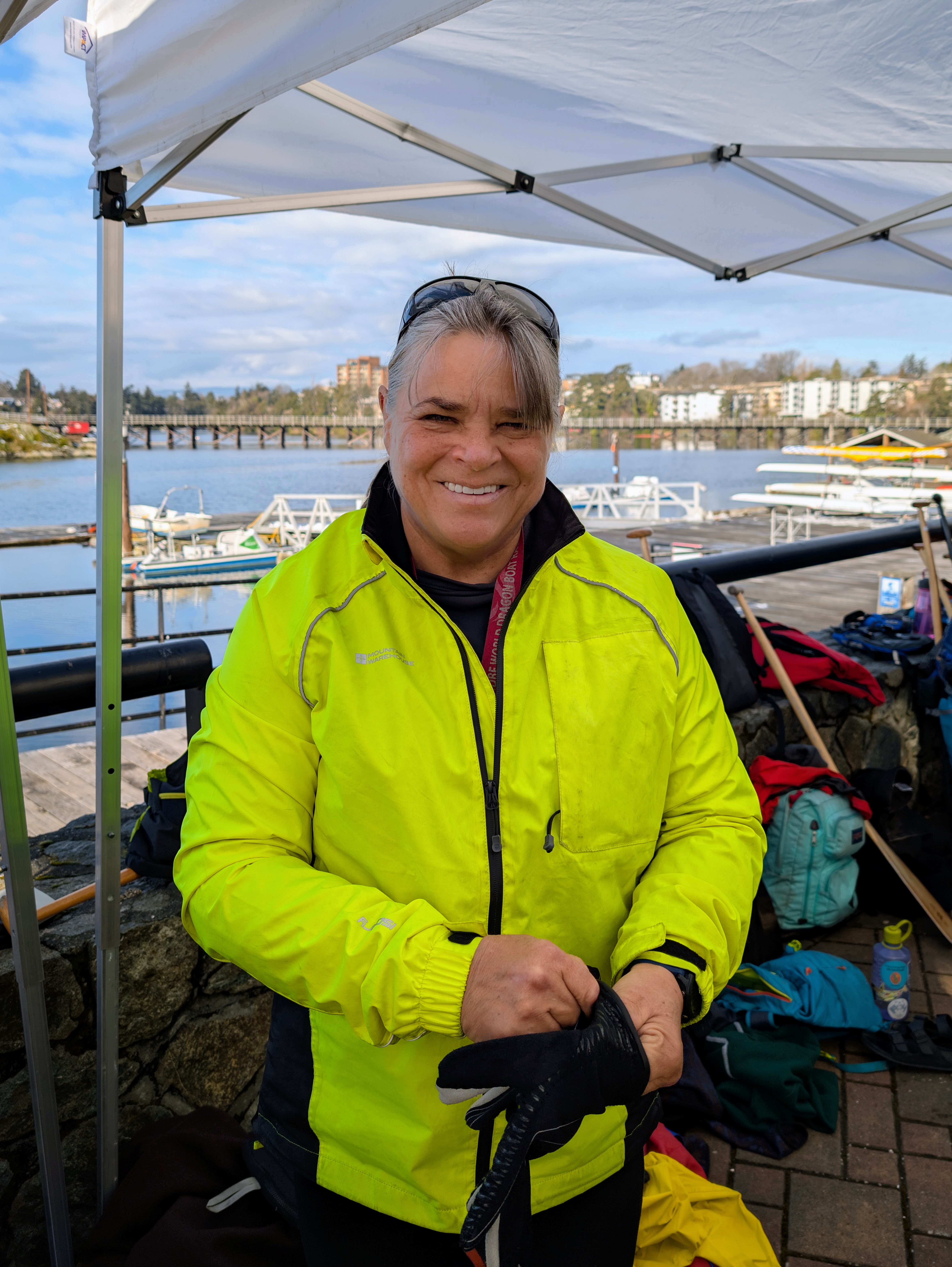
Our team and steersperson, Sue
Upping our game
How did we end up in a Race? To challenge ourselves this winter, we register for the October to March session of the Daytime Recreational Outrigger Series at the Fairway Gorge Paddling Club. “Just bring your enthusiasm and a love for the outdoors” says the program description. We can do that, right?
We feel as if we’ve won the lottery when we snag a spot in this popular program. We are two of the very few newbies joining the group of regulars on October 1. Kathy, who leads the warm-ups, is happy to welcome another Kathy/Cathy to the group, in which Kathy/Cathy is the modal name.
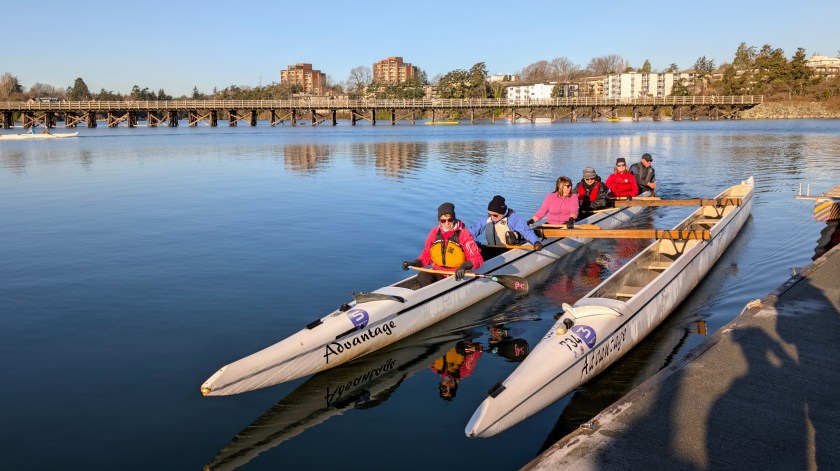
What brings people to outrigger canoeing? “It’s where old dragon boaters go” is the saying. Here is a sample of reasons people give us:
- I started outrigger canoeing as cross-training during the dragon boat off-season. I liked that we could paddle further and see more, through the Harbour and beyond the breakwater. It was a pleasant change from those head-down 200-metre sprints.
- My friends were doing it, and they encouraged me to come along.
- I needed to find a sport that I could do, when my knees told me it was time to retire from marathon running.
Many of the Daytime Recreational people are starting to slow down from competitive paddling. On Fridays a big bag of cookies often appears, a sign that this is a recreational group. For us, this program is a big step up from the slothful paddling pace we have practised for thirty years. We know we aren’t going to be as powerful as others, so we set ourselves two modest goals: (1) perfect attendance at the practices (Tuesdays and Fridays for Cathy, Tuesdays-only for Doug) and (2) participation in the Valentine’s Race, “a fun middle distance race that is available to everyone.”
A romp of river otters
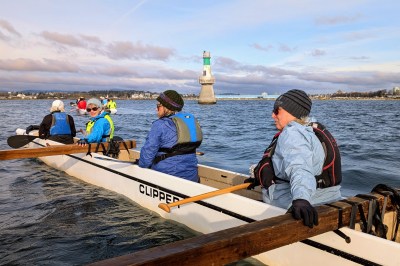
A playful group of 11 river otters, 75 cormorants (some spreading their wings to dry), several harbour seals: all sighted on one brisk (five degrees Celsius) paddling day. A water hover board, a deer on an islet, an eagle perched on a No Trespassing Sign, and a huge sea lion are observed on other days, in addition to the everyday marine traffic in Victoria’s working harbour: ferries large and small, float planes, floating hot tubs, yachts, tug-and-barge combinations.

Our practice routes often take us through busy Victoria Harbour to the entrance buoy V21 or to Brotchie Ledge. Other days we head up the Gorge Waterway to challenge the reversing rapids at Tillicum Narrows and on into Portage Inlet. In December there’s an optional evening paddle to view the Christmas lights in the harbour.
Our two instructors are skilled, patient, and kind. As steerspersons, the instructors are clearly in charge of their boats, but their coaching styles are all about encouragement rather than correction. Bill, who likes a quiet boat, exudes calmness and patience as re reminds you to paddle “in together, out together” and “long in the water.” Sue is exuberant as she talks about your “dance space”, even more so when she chases waves. Need a new rain jacket or a pair of wool socks? Sue can tell you where the bargains are to be found.
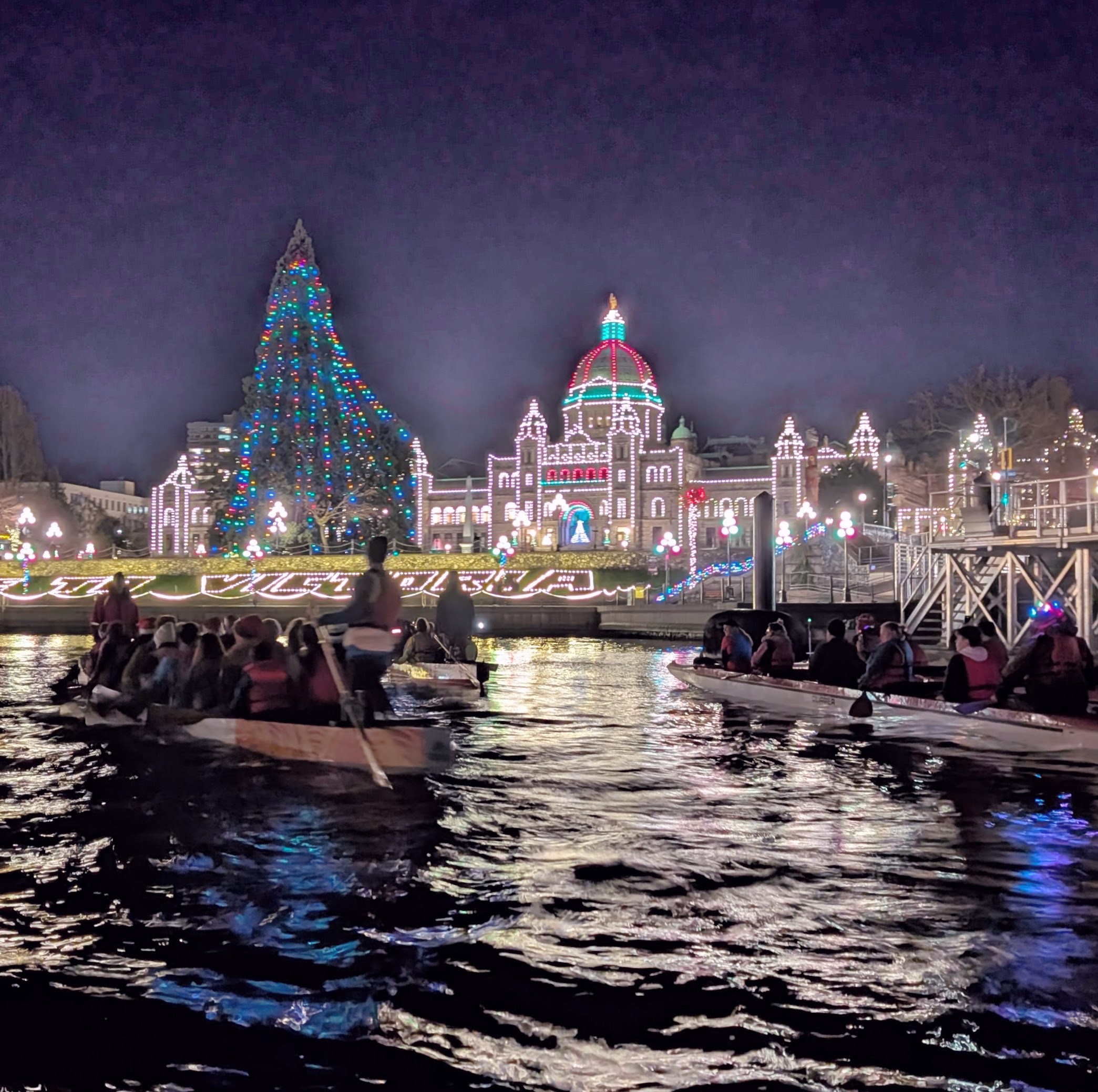
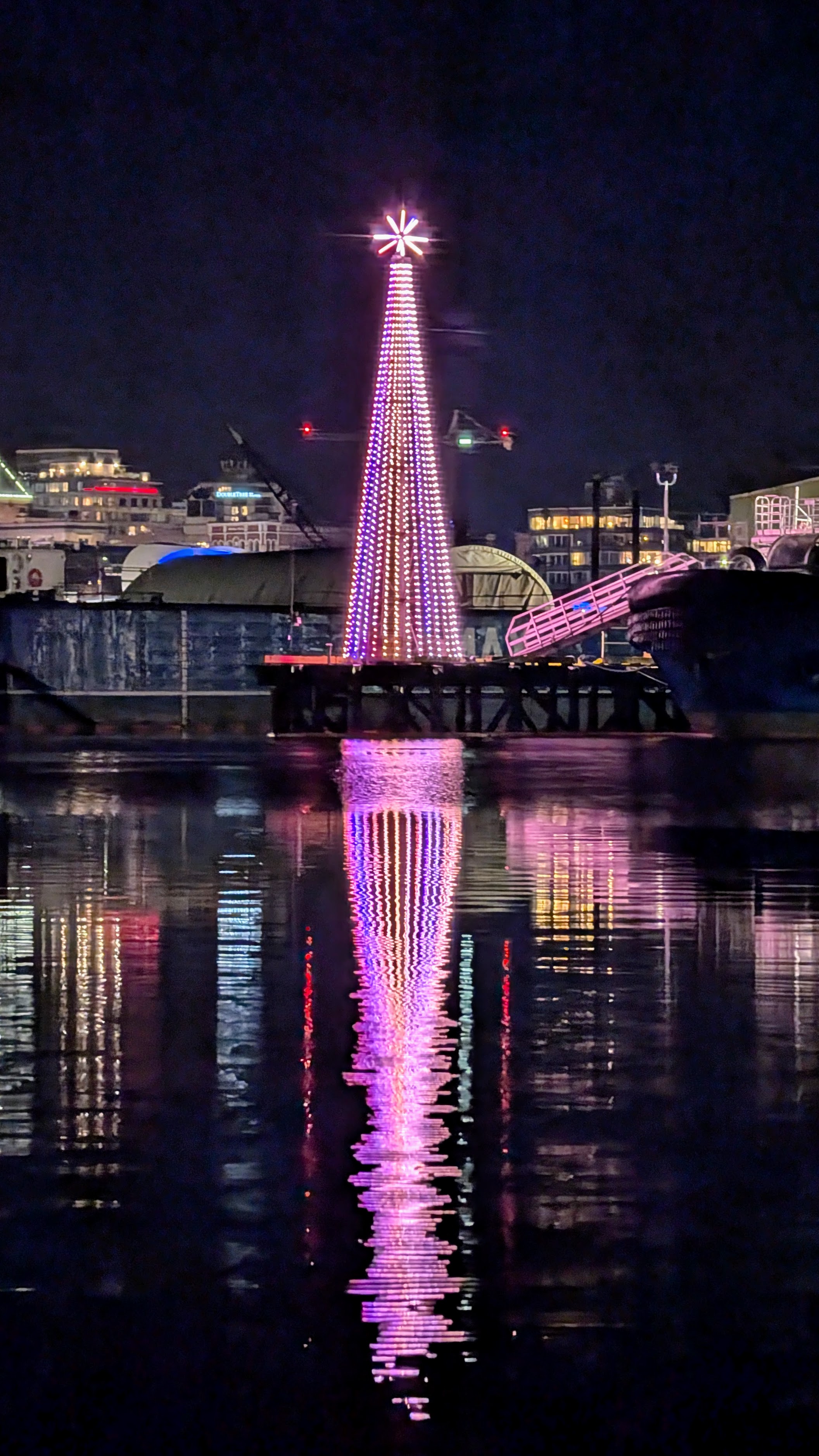
Evening paddle to view Christmas lights in the Harbour
For our tripping friends
How is recreational outrigger canoeing different from tandem canoe-tripping, our usual style of paddling? As many of our readers are tandem trippers, we offer (below) a comparison table, which will give you an idea of what to expect if you join a V12 outrigger team.
Daytime Outrigger Canoeing and tandem canoe-tripping are different genres, but they share this ethos:
- respect the canoe
- trust your team, and
- take care of your paddle. Paddles up!
| Daytime Recreational Outrigger Program vs Canoe-tripping | ||
| Recreational Outrigger | Canoe-tripping, our style | |
| Boat | Double hull outrigger canoe (V12, 12 paddlers) | Tandem (two-person) canoe, our own or rented |
| Goal | Practice paddling technique in a team setting, led by friendly and knowledgeable instructors | Complete a multi-day journey on a river or a series of lakes |
| Stroke rate | about 60 strokes per minute | Slower than that |
| Cruising speed | 8 kmph | 5 kmph on flat water |
| Distance covered | about 10km in a two-hour session | 15-30km per day on flat water. 50+km on a swift river, e.g., the Yukon |
| Switches | Seat 3 calls “hut, ho” every 12-14 strokes | Doug calls “hut” when he gets tired. On unobstructed flat water, we switch every 15-20 minutes. When conditions necessitate an urgent switch, either paddler can call “hut.” |
| Our roles | As newbies, we are usually assigned to Seat 5, towards the back of the boat. Paddling forward, in time, is our role. | Bow paddler (Cathy): Paddle forward at a consistent, cheerful pace. Watch for obstacles, fine-tune the steering, take evasive action as required. Stern paddler (Doug): Navigate, steer (big-picture), call switches, take photos, track progress (with Locus Map), paddle forward (occasionally). |
| What to bring in the boat | Nothing except for pfd, paddle, and maybe a water bottle. Valuables are left in a storage box on the dock. | Camping equipment. At a minimum (for a day-trip), a lashed day-bag containing duct tape, a few pieces of rope, cable lock, first aid kit, toilet kit, a light, rain gear, spare clothes, small towel, two Clif bars, trip plan, emergency contacts… |
| Heart rate | In the Vigorous or Peak zone, according to Doug’s Fitbit. | In the Moderate zone while paddling. Portaging or making/breaking camp can be Vigorous. |
| Communication etiquette | Chatting is allowed during water/cookie breaks. While paddling, silence is golden; focus is on timing, technique, and listening for switches and instructions from the steersperson. | Chatting is allowed any time on flat water or easy rivers. In challenging places, no idle chatter, but either paddler can give directions, by pointing, leading by strokes, or speaking. |
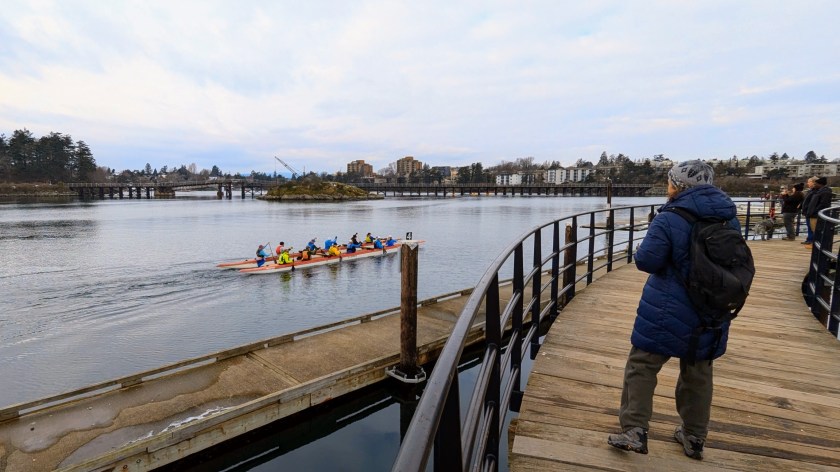
 Boots Boats Bikes
W
LikeLike
Wow good for you two. Keep it up. Margaret
LikeLike
Thanks Margret. Yup, we’re still alive and kicking. Hope you are doing well.
LikeLike